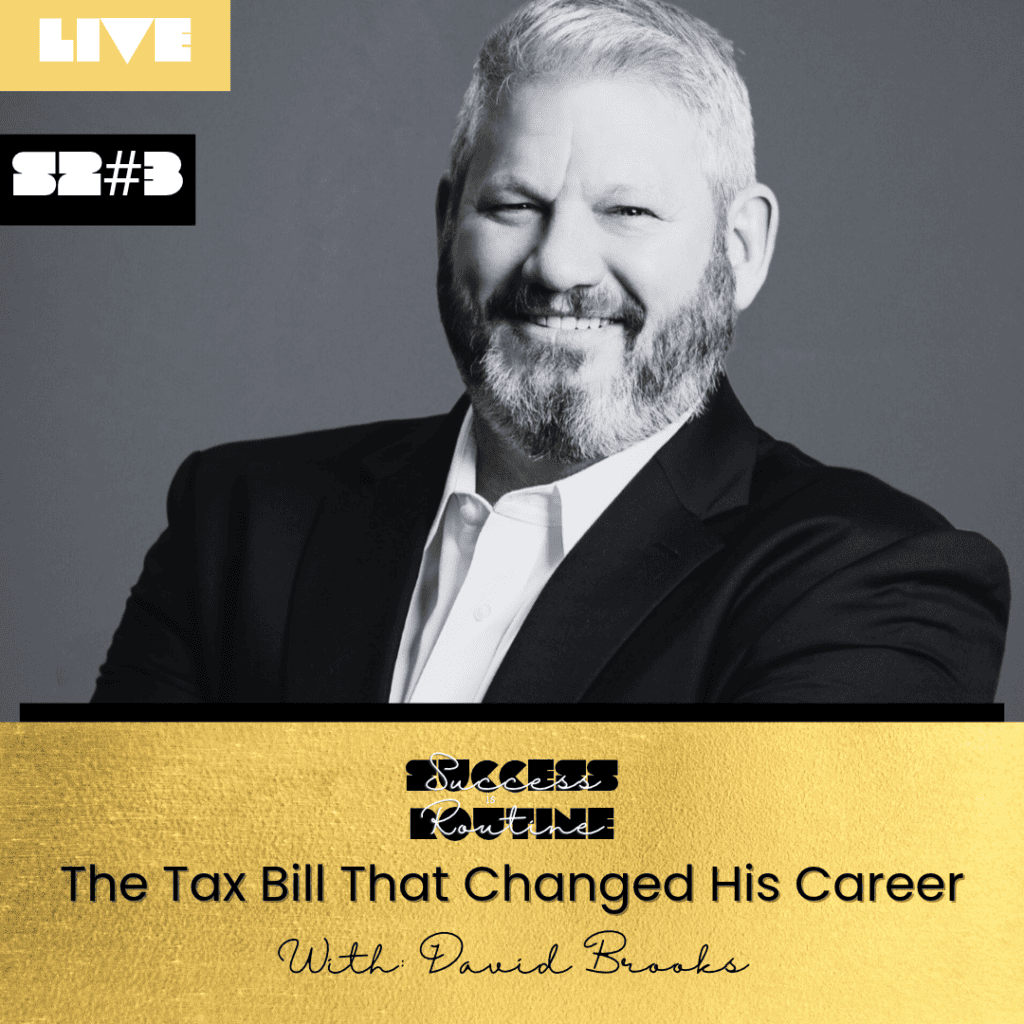
Building a successful business sounds great. But what happens when that success starts costing you what matters most? David Brooks went from running four pizza shops to working 80–90 hours a week, until missing his son’s third birthday made him rethink everything.
In this episode of Success is Routine, Hannah Mitrea sits down with David, founder of Retire Smart, to talk about the decisions that changed his life. From selling his business to receiving an unexpected tax bill years later, David shares why financial success isn’t just about how much you earn, but how much you actually keep.
And with recent U.S. elections raising questions about taxes, regulations, and the economy, David offers an interesting perspective: “Don’t worry about the party or the politician. Worry about the policy.” But how much do those policies really affect your financial future?
Beyond money, David shares how he built a company of nearly 50 employees, why he protects his calendar so carefully, and what spending time with Richard Branson taught him about entrepreneurship. He also challenges some familiar ideas about education, productivity, and retirement.
Key Takeaways:
(5:37) How four pizza shops changed David’s idea of success
(7:19) From restaurant employee to building his own business
(10:54) Market losses and the tax bill that changed everything
(14:19) Starting over in Omaha and building a growing team
(16:32) Why retirement income depends on what you keep
(20:57) Focusing on your strengths instead of your weaknesses
(23:42) Using calendar discipline to protect your time
(25:10) Why routines must evolve as responsibilities grow
(28:07) Learning from Richard Branson and other successful entrepreneurs
(31:59) Rethinking college, career choices, and lifelong learning
(33:34) Defining success through freedom, purpose, and choice
For David, “Success is doing what you want to do when you want to do it, and as much as you want to do it.” But what does it actually take to reach that point? Watch the full episode to hear how his experiences shaped that philosophy and the routines behind it.
About David Brooks
David Brooks is the founder and CEO of Retire Smart, a financial planning firm in Omaha, Nebraska. A lifelong entrepreneur, he transitioned from running a successful restaurant business to financial services, specializing in tax planning, risk management, and retirement strategies. Today, he leads a team of nearly 50 employees and hosts the Retire Smart Podcast, helping people make smarter financial decisions and build a future with greater freedom and purpose.
Contact David Today!
- Website: Retire Smart
- LinkedIn: David Brooks
- Podcast: Retire Smart Podcast on Apple Podcasts
Be Our Next Guest!
Your success story might be the spark someone else needs.
Behind every breakthrough are decisions, setbacks, and routines worth talking about. We want to hear yours.
Have a story worth sharing? Join Hannah Mitrea on Success is Routine. Let’s get you behind the mic!
Disclaimer:
The content of Success is Routine is provided for informational and educational purposes only. The views, experiences, and strategies shared by guests are personal to them and should not be considered professional, financial, legal, medical, tax, or business advice. Always consult an appropriate qualified professional before making decisions related to your personal, professional, financial, or business circumstances.
Transcript
Hannah Mitrea 0:04
Hello, everyone. This is Hannah, your host, and you are listening to the Success Is Routine podcast. Our show is on a mission to talk to leaders in life and business that have achieved success, and to learn what their routine is. If you are ready to create your routine to success, you’re in the right place. Now let’s get started. All right, welcome back everybody to Success Is Routine podcast. I am super excited for today’s guest. David Brooks is the founder and CEO of Retire Smart. David’s journey began building a successful restaurant business from one pizza shop into four, but that success came with a cost: 80 to 90-hour work weeks and missed time with his family prompted him to sell the business and rethink what success should look like. So his next chapter led him into financial services, where personal experiences with market loss and significant tax bills shaped his focus on risk management, tax planning, and helping people retire smarter. Building and selling an independent financial firm in Florida, David moved to Omaha and started again. So today we’re going to explore his routine, disciplines around scheduling, and the ability to say no that have helped David’s business and navigate setbacks, creating lasting success. So David, welcome to Success Is Routine.
David Brooks 1:23
Hey, glad to be here, Hannah. So, enjoying the show. Let’s go.
Hannah Mitrea 1:28
And I’m excited. I know when we first talked, I was like, I have so many questions. Let me narrow them down though, because we just have a 10-minute call that time. So, I’m really excited to talk to you and just talk about your story and how, you know you went from Florida to Texas to Omaha, like you had a lot of those changes in between. So, and you know, a quick little snapshot here. What was the journey for you, and why did you get into the financial world?
David Brooks 1:57
Well, I I’ve been a serial entrepreneur. I figured I wanted to be a business owner actually way back in high school when I ran a couple of side projects and I actually worked for a franchisee of a big national chain and you know just really liked the idea of being the owner of something. Obviously, when you’re really young and you don’t have a lot of capital, not a lot of opportunities to do so, but I ended up working in basically the pizza business while I was in college working for the largest national chain Domino’s Pizza, and ended up going through their management program, running one of their most successful stores outside of Disney World’s doors in Central Florida. Started to make really, really good money running a place, and basically had signed up to be a franchisee. So that was going to be my first launch of a business, and long story short, they kind of changed the rules. The founder, Tom Monaghan, who started that great franchise, sold out to a basically to a venture capital firm. And as they will do, they, you know, changed the rules a little bit and wanted more dollars for royalties and advertising spend, et cetera. So I just said, you know what, I’m going to do it on my own. I don’t need them, and I ventured out on my own. I opened up a pizza place on my own with the knowledge I had learned, and that was called Stadium Pizza. We were themed after baseball, and very early, the reason we did that is I got the contract for the Houston Astros spring training facility. So that was a nice little coup early on. But we ended up getting into public school lunches, so we did like 19 public school lunches. Anyway, one store turned into four. It was a lot of fun being the owner, but then I started to have children, and you know, and as you mentioned in the intro, working 80 to 90 hours is very realistic in the restaurant business because if somebody doesn’t show up, you have to, or your unit’s not going to be open, so came with some challenges. And after missing my own son’s third birthday party, when I got home, my wife crying. It was kind of like, okay, maybe it’s time to try a different business. We’ve done this one successfully, and so we end up selling it. And as that got sold, I was for the first time in my life getting handed a large check, basically had two commas in it, and so it was a thrill and exciting. I was still in my late 20s, basically, when this was happening, and I had a relationship with a stockbroker, and that stockbroker basically worked at a company called PaineWebber. It’s an old Wall Street firm from the 1800s, where I had traded stocks and commodities for a few years, but that was more what I would call speculation capital. You know, that was just me having some fun in the markets. And if you know anything about market history in the 90s, the markets did really well. So seemed like everybody could be a genius in the markets at the time. And anyway, so I come to him looking for some long-term financial planning, some guidance with my new nest egg as I’m walking away from the business I just sold, and basically kind of talked me into coming to work there. You know, I’m like, wait, what? And to put it bluntly, he’s like, hey, you got a good personality. You’ll need that in this business. You do more research on the stocks and stuff already, so you’ll get the analytical side of this business. You just got to get licensed. Etc. And I kind of had to look at him like, you know, I didn’t finish school. I dropped out of college. He goes, they don’t care. If I recommend you, we’ll get you hired. And if you want to go back, they actually have a tuition reimbursement program. So I did. I actually joined PaineWebber, and basically that was, gosh, almost 28 years ago now. And I did. They paid for me to finish school, so I graduated college.
David Brooks 5:20
So 15 years after I started, so I always tell people it’s never too late if you want to do it. But anyway, that became a really fun and exhilarating career, but also came with a lot of hard learning. So early in my career, just getting into it in the early years in the late 90s, the stock markets was almost going straight up. Well, then we had that what’s known as the dot-com crash, right? So the only time in anyone that’s alive today’s lifetime, and it’s only happened twice in history. The other time was over 100 years ago during the Great Depression. It was we had three consecutive losses on the all the major indices and all the investments, double-digit losses three years in a row, and so the markets lost about 57 percent from peak to trough over a drawn-out three and a half year bear market. Very, very difficult time. A very difficult time to get into the fund services business. And anyway, persevered, stuck it out, made it through that. And I thought it was going to be sunshine and roses. And then I got a letter in the mail from an organization no one wants to get mail from our taxing authority here in the U.S., and so I had a very, very large tax bill with penalties due, and this was from the transaction that was now about five years in the rearview mirror because I didn’t get proactive and competent tax planning on the largest transaction of my life at that time when I’d sold the business. So from that day forward, I realized, you know, the markets have risks. The markets are going to make money long term and help clients grow. But if I don’t focus on the tax code and understand it’s not what you make, it’s what you keep. You know, I knew I was going to be in trouble. So that got my routine going of studying, and I’ve been a lifelong learner. I’m still constantly learning and understanding things. But I’m like a little bit of a tax savant and be able to memorize the code and use the incentives in the code to help our clients, you know, mitigate or reduce or sometimes even eliminate taxes that they’re not, you know, by law actually required to pay. And Hannah, I want to make one thing clear: is when it comes to proactive tax planning, it’s not tax evasion. We’re not trying to, hey, I don’t want to, I just don’t want to pay that tax. That’s not it at all. It’s understanding the tax code puts incentives, and by our research, there’s over 1,700 incentives in the tax code to help you do things and pay less tax. And the reason for that, so people need to understand that, is why would the government do that? Well, they incentivize you to do something that actually benefits the economy and the government as well. Easiest way to give an example that is charitable giving. My wife and I are blessed to be able to pay hundreds of thousands of dollars a year now to charities that matter to us. But I think everybody should learn about how to help those less fortunate than themselves in whatever way you can do it. And if you can’t give money, give your time. But if I were to go to a homeless shelter and donate $1,000, they can feed people for about $2 a meal, right? They do it with efficiency. They help people that are in need. Where if the government were to go in and try to feed those people, they’d have to hire people. They would, you know, the bureaucracy and the admin. It would cost the government way more money to actually get the same benefit for society, so therefore they want to incentivize us to help charities, and therefore you know give charity a donation, you’ll get a tax deduction, right? So that’s how the incentives work, but they work on a multitude of scale. You can get incentives for starting a business. Small business owners have massive incentives available to them in the tax code today. So interesting.
David Brooks 8:41
Understanding that became the routine as we started helping our financial clients, and then eventually I left the big box world and started my own investment firm back in 2010, and that became our routine as we looked at everything through the tax lens first, and that helped me grow successfully that business. And then we were acquired by a much larger firm in 2017. And as you mentioned, I ended up moving to Omaha, Nebraska. I actually got recruited here to do tax planning for a different firm because my wife thought, “Oh, good, we’re not going to have to be the business owner. We’re going to have to make payroll. We’re not going to be doing all this.” And I was literally going to work for someone else, but that did not work out. But God had a plan for us. We loved Nebraska and Omaha, so literally about six months after we moved here, we ended up starting our second investment firm, and that’s where we’ve been for the last. We just celebrated nine years, our firm’s anniversary, and we have made the Inc. 5000 fastest-growing companies in America list five consecutive years, and we’re quite proud of that because, from what I’m told, it’s only a few hundred companies have ever actually done that. So, and now we employ almost 50 people here in Omaha, Nebraska. But it’s just been a fun ride because what we do every day is we get to help people. We get to put them in better situations when they walk in our doors. And now I get to help and bless all my staff as well. And so my mantra: I’ll take care of the staff. They’ll take care of the clients. That’ll give us the revenue. We’ll be able to take care of our community through our charitable giving, etc.
Hannah Mitrea 10:06
Yeah, I love the loop there of things. I know we share a very common value in that. I always say like my team, if as long as they’re happy to come here, they will take care of the clients. Yeah, absolutely. My goal is just to make a place where they want to be every day, so I love that, and I love that you look at it from a tax side. I feel like a lot of times, especially when we get into the financial, like wealth management, retirement, like yeah, there’s tax strategies, but a lot of the time we’re still just looking for how do we increase the get the max return for stuff. And as much as yes, we want that, we have to understand that tax code, and I completely agree. It’s not tax evasion. It’s using the tools that are there to one help in the ways we want while still being able to get that other side of it.
David Brooks 10:51
I’ll give you a couple examples. Just you know, it’s going to be in your future in a while. You’re a little young, but you know, when you eventually decide to get to retirement age, right? Our government has basically a subsidized income plan for when we get in retirement called Social Security. You pay through it through your payroll checks, and of course, a self-employed person you pay both halves of that tax, right? So you want to make sure you understand how to maximize that benefit. Well, Social Security was never meant to be taxed. However, that changed back in 1983. So now we start taxing your Social Security benefit, but only if you have other taxable income. So it’s again, it’s really important understanding the routine of understanding what we do when we do what we call income planning for clients. We’re trying to show them how to have more income every year, inflation-adjusted, written income plan. They know what account income is coming from and how it will be taxed. How much do you get to keep? You know, because you know, when I was a kid, the big number you played Monopoly was to become a millionaire, a million dollars. Now, a million dollars is not today what it once was 30 or 40 years ago. It’s still a significant number. But would you rather have a million dollars in a 401k or would you rather have, you know, $700,000 in a Roth IRA? Well, for most people, they’ll get more income out of the Roth IRA because what they take out of that is 100% theirs if they’re following all the rules. So it’s so there’s so many complexities to this, but the Roth distributions will not trigger the Social Security income to be taxable, right? And then there’s Medicare tax penalties if you make too much income according to the government size, and this happens to a lot of our parents. They saved and saved and saved, and they’ve got the money in a 401k or an IRA. And then when they’re forced to take that distribution out, called a required minimum distribution, it pushes them into another tax bracket and it pushes them into Medicare penalties. And of course, right now we just had some elections here that have had some consequences in our country. And again, that’s the great thing about the Republic of America. We have 50 different states that do things slightly different. So I say we have 50 different experiments, and there’s a thing in finance called Wriston’s Law. Capital will go where it’s treated best, and we’ve seen this migration of companies leaving some states because of regulation and taxation issues, and moving to states that don’t have it or have less taxation and regulation. And so capital is going to go where it’s treated really well, you know, and it’s not going to pour into places that’s going to treat it badly. And so, you know, elections have outcomes and consequences. I’m not telling anybody how to vote, and I’m not a neither party of the right or left. I’m an independent, but I analyze the policy. And one of the things I always tell people, I have a radio show here and locally, is don’t worry about the party or the politician; worry about the policy. What policy will they implement, and how will that affect you, or how will affect my clients? The way I look at it. So, anyway, yeah, it’s just been fun really diving into the tax code and then showing people how important that is into things like your income planning, your retirement planning, how much you keep. Like if you buy an investment and sell it later, do you understand the difference between short-term capital gains, long-term capital gains, and alternative minimum taxes, net investment tax, etc. There’s these taxes most people don’t even know are there until after the fact. So you want to pre-plan for as much of this as possible.
Hannah Mitrea 13:51
Yeah, I was like, that is especially when you start talking about every single state and how they’re all slightly different. It’s so true, and especially for so many of us that don’t stay in one state. Well, I have a. I give an example.
David Brooks 14:04
I have a really good friend. He lives here in Nebraska. He’d be a celebrity. You would know the name. Been in Disney movies. Very big celebrity that has a shtick that he goes around and done comedy for many years. Well, each year he performs sometimes in 30 to 40 states, so he has to file 30 or 40 state tax returns, right? So think of the complexity of folks that are for doing that in the entertainment business, even football players, right? NFL or whatever, pro sports. You know, these every time they play a game in a certain state, they have to, you know, they got to pay taxes to that state if they charge it. So,
Hannah Mitrea 14:38
Yeah, didn’t think about that. That’s wild to think about those sides of it. So I love like how you got started. The passion I can hear it. So and I appreciate having you on, David. Somebody that is so knowledgeable in that. And so you had a huge trigger that kind of threw you into this. You know, getting that tax bill from the IRS. And so when we start looking at routine, what is like? When you switch over to that, and for you know the listeners, what is that routine they need to kind of have in place, especially when making sure that they are following the right steps, they’re checking the right boxes to be prepared for these tax burdens.
David Brooks 15:13
Well, on the grander scale, it’s really simple. We have a motto here: do the right thing for the right reason at the right time. If you simply follow that mantra, you know that’s going to keep you in good graces. You’re probably going to have a great outcome. But when it comes to work, the biggest things that will help you be successful is understanding where are your unique abilities, what are you good at, and you know, when you know I’m old, obviously all this gray hair, right? When I went in grade school, you might take six core classes a day, and what they focused on is your weakness, right? Oh, you’re getting an A in math, but you’re getting a C in English. We need to tutor you up. It’s just the opposite the way the real world works, right? If you have skills that you’re really good at something, you should actually go get better at that, become the best at that, and don’t worry about what you’re not good at because you’re never going to make a great living doing something you’re not good at, and you’re probably not going to enjoy it. So the key to success, whether it’s in a career or as an entrepreneur, is to focus in on what you know. Dan Sullivan, who owns runs a company called Strategic Coach, helps entrepreneurs, but it’s basically focusing on your unique ability. What do you do so well, that’s where you should spend 80% of your time, and then the 20% is for those other things that you have to do but necessarily don’t want to do, and then you’ve got to reprocess that every year. You got to basically give away more stuff and get even leaner and focus in on now 80% of the 80% and give away another 20%, even though you’re probably really good at some of these things, it’s still not the best use of your time. So, you know, I used to sit down and meet with clients six, seven meetings a day myself, running the investment firm. But that is no longer the best use of my time. I’m in a couple of meetings a week for high level strategy appointments, but I have trained basically almost two dozen advisors here at our firm that do the day-to-day meetings with clients, and I teach them the strategies, how to implement, et cetera. So it’s really you know focusing on always being a lifelong learner and always improving upon the things that one you enjoy doing and two that you’re really good at. And if you can’t check both those boxes, you’re doing the wrong stuff.
Hannah Mitrea 17:19
Yeah, I was like, that’s great advice for just everybody. I was teaching the 80/20 rule. I teach a community college here, so I was doing that same thing just this week. This 80/20, 80% of what you do is that 20, you know, is the impact from the 20% of what’s happening, really. And so I think that’s a really good thing to do, and really think about like your time and your schedule, and I know something we talked about too is how your calendar is so important to you. And if it’s not on it, you’re not doing it. If it’s on it, you’re doing it. So I appreciate you being here. I know that the market’s a little crazy, so I’m glad I was on your calendar.
David Brooks 17:55
But I didn’t put it on the calendar, right? That’s the other thing. Understand is delegating. I’m not though. I don’t read my email. I don’t look at my calendar. I have an assistant that does all that for me, and I do. I just follow the calendar when the phone tells me where to go. That’s where I go. I got notice about seven minutes. We were supposed to. Oh, that’s right. I’m doing the podcast. I’ll get a glass of water and I’ll pop in there. But that is so true. Is if it’s not on my calendar, I’m not doing it. Somebody could give me a task. And reality too for busy people, whether you’re just a busy boss at work somewhere, or you are the owner of a company, when you have as many employees as I have, almost 50. When I walk down the hall, can I get two minutes? Can I get two minutes? Can I get two? The stop-ins will eat up. If I stopped and gave every employee five minutes a day, I’m going to lose half my day, right? Just there. So have to be really disciplined. But then you also have to let your team know when you do have capacity, open door hours, whatever you want to call it. Hey, if somebody needs me, I’m available these two hours. Just come by my office; I’ll be waiting for whoever needs to pop in and talk to me. But it’s discipline that gets you where you’re trying to go, and calendar management is one of the ways I’ve been able to really focus and grow.
Hannah Mitrea 18:59
Yeah, I would love to, because I feel like we hear a lot of that around the calendar and making sure that we’re staying disciplined to it. So, what were those maybe like steps, or maybe those like that you told your assistant like, hey, these things are priorities; these are not. What did that look like for you? Julie defined what should go on your calendar, what shouldn’t go on your calendar.
David Brooks 19:20
Well, I will tell you when you lead a team, and if we go back nine years ago or eight, just eight years ago, my team had five people on it, right? And so I could meet the needs of all five people without total disruption. And so you have to be able to willing to adapt and change your own rules as you scale or grow your responsibilities or your company, whatever it may be you’re doing, and so that’s where you have to literally be able to adapt for the rules that you set today, and the tools used today will change. I mean, for instance, AI assistants are revolutionizing productivity in clerical and office space, and we’re implementing some of those things, and we’re still investigating some of them. We’re in a highly regulated industry, and so we have to be very very strict on you know sensitive client data. I mean we have a tax firm here. We do tax returns, etc. This is highly sensitive data, and so we have to be very careful in which tools we allow people to use. But I would tell people today, with the advent of just some kind of assistant or using you know a tool like a ChatGPT or a Claude or you know any other AI tool, you can really get dialed in, and I mean, just think of the advent of Alexa, right, or Siri on an iPhone, and how you simply set reminders. I mean, I know that’s how my dog gets his medicine every month. Is you know, Alexa tells me, right? So it’s learning to adapt to the tools of your environment. Now I’m so old. We would go back to Franklin Covey and the you know habits of successful people, but he would sell the organizer that we would run you know basically our data book that that’s where our calendar was in the old Filofax, if you will, and you would walk around with this organizational tool. You didn’t have it on a device in your hand yet. People that learned how to utilize those tools of the day the productivities were the ones that stood out and started to grow, and that would tell you one of the other big things. A routine that I am highly, highly involved in, is constantly putting myself in rooms with people that are ahead of where I want to go. So you know, for me, it’s typically conferences or what we call masterminds. Now, these do happen virtually for a lot of people. I’m not a virtual person much. I much prefer to get on a plane and go somewhere. In fact, I’m doing that this Sunday. I’ll be jumping on a plane and talking with other successful advisors in my community about a very unique, specific topic. But we’ll spend two days together brainstorming how to achieve something that’s beyond where we are at the moment. But the only way to do that is to put yourself in rooms. You know, there’s the old adage: you’re a product of the five people you hang out with, and that is really, really true. So you’ve got to be focused on who you allow to eat up your calendar space. Who are you spending time with, and is that productive and moving you in the right direction? Whether that’s spiritually, financially, or your personal goals and fun, etc. But the same rule applies regardless.
Hannah Mitrea 22:01
Yeah, and it’s so powerful. I know the, these are time traditions and you know lessons we’ve learned, but they’re still so relevant to today because really it’s about getting that room, that learning you talked about earlier, and combining that.
David Brooks 22:15
Well, that’s it. There’s no secret, right? Everybody always tries to tell you we’ve got this magic thing. We’re gonna make you no. You know, just be a lifelong learner. And I will tell you, that’s another thing. I believe you know readers are leaders, and I’ve gotten a room with some great people. I actually got to spend a week with Sir Richard Branson earlier this year on his private island that came about just out of the blue. I got a phone call from a billionaire friend of mine who actually invited me down on a private jet, and it was a great experience for me and my wife. But we didn’t think he’d actually hang out or be there. Literally, Sir Richard Branson hung out, played poker in his house, played tennis with him. But he literally gave us some great ideas on business, which he’s you know multi-billionaire, self-made, Virgin Records, Virgin Airways, Virgin Cruises, and many other, you know. But here’s the one of the things that’s unique too. We’re talking about get back to unique ability, like do something you enjoy. Well, every company he started, he said he started because it was a frustration. Like British Airways, he couldn’t stand the way they take it because they kind of dominated out of Great Britain, right? And their customer service lacked because they had a monopoly, basically. So he said, “The heck with that!” and basically started Virgin Airways, right, and started just to compete. But you know, so that’s and you see this across the board with entrepreneurs that create products to create things that just didn’t exist. I mean, and the same in industries that didn’t exist, right? So, you know, when I graduated high school, this is going back over 40 years ago. You know, half the industries people work in today didn’t even exist at the time, and just 10 years in the future, there’ll be career fields and industries that we don’t even know what they are yet, and that’s the advent of time. But so the rule is always be a lifelong learner, and it’s the old tried and tested tools, the tools that we use, right, the technology we use, and the skills we get to get there will certainly change. I think you know big changes coming in the world of education, right? The traditional college experience, as I thought it was going 40 years ago to college, is you went there and you kind of took all these prerequisites. But you know most kids, and you can go study the history. Most kids did not graduate in four years, right? It was actually closer to seven because they would change majors at least twice because their friend was, oh, that’s interesting. They didn’t, and who knows what they want to do when they’re 17? You’re signing up for these things, right? So today, though, I don’t know if you need to go to college, and I’ll be frankly with it. I told both my kids, I have two boys that are adults now. Don’t go until you’re sure about what you want to go. I’m happy to pay for it, but don’t waste my time or energy. Like when I went, I had no clue what I wanted to do. Right, I dropped out and ended up, you know, being a pizza salesman, right, and open up pizza restaurants. And so, you know, the thing is today is you can get all the information available on the internet. There is so how do you focus that in? And then the other thing is block out the white noise, right? You know, social media feeds. Certainly, I’m guilty of doing that a little bit too. But I mean, you can waste an inordinate amount of time on things that do nothing to move your life forward spiritually, financially, or you know, with your you know relationship-wise with your significant other or your family, etc. So think about where you spend that time, and I think when you get really really disciplined, and I still have plenty of room to grow, but those disciplines really really help you move forward.
Hannah Mitrea 25:30
Yeah, no, I agree with all of that. As a college professor, I agree with what you said there, 100%. Though my husband’s daughter, we told her the same thing: don’t go to college until you know what you want to do, because you’re going to waste your time. And as an instructor, and I’m seeing students come in there, and I know their parents are forcing them. I’m always like, I’m glad you’re here, but I know you don’t want to. And even in academia, we’re seeing it. We’re talking about how every couple years we’re going to be redoing our curriculum, making sure it’s staying with industry standards. And well, you know,
David Brooks 26:02
I can tell you just hiring. I’ve, you know, had companies for over 40 years now, and I’ve hired people through decades now. I really don’t care where you went to school. Now, let’s if you want to go be a doctor, you should go to college, right? There’s certain career paths that I think still makes perfect sense, but for a lot of career fields, and if you’re not sure, the great ways to do this is community college, right? I mean, community colleges are everywhere, and they’re really inexpensive relative to traditional college. Just to go start, and that’s why I encourage my kids. They each went and took like one class, get stimulated, and you know what? I do want to great. Let’s go. But you don’t need to sign up for the you know 18 credit hours day one, if you’re not sure, but if you are, that helps you actually you know get really focused and get through school accelerated. My older son, he’s gonna be 31 here shortly. He did not start college till I think he was 25. He was kind of did some odd jobs, worked in restaurants, and was trying to figure it out. But then he you know something lit a fire under him, and then he went, and he knocked out a bachelor’s degree in about two and a half years because he was there for him, focused. And now he works in radiology and has a great career. Works for a huge hospital out in Seattle. And but I mean, you know that these are the things, man. Be focused on. Figure out what it is that’s going to make you happy. What do you want to do, and what do you need to do, right? And it’ll help you make choices better.
Hannah Mitrea 27:21
Exactly, and it goes right back to what you said: do the right thing at the right reason for the right time. So true. To kind of wrap this out, I would, you know, leaning on that. How do you define success? So, what does success look like for you in your life?
David Brooks 27:36
Success is doing what you want to do when you want to do it, and as much as you want to do it, so, you know, when we set up financial planning for folks in retirement planning, our main company is called Retire Smart. I don’t necessarily want you to retire. I want to show you when you’re WELO, which is W-E-L-O, worker or entrepreneur, life optional, right? Do you still have to do what you’re doing, or can you walk away if you choose to? And we find that once people get to the point of knowing financially they’re going to be okay, they’re not going if they quit tomorrow they’re not going to run out of money. We’ve built all that out, then they actually enjoy work even more. And many of them will work for another decade. Let’s face it, we need purpose in life, and for some people it’s working. For some people, just want to get out of the rat race as soon as they can, once they’re financially able, and want to spend their time volunteering. But I can tell you, somebody who’s we’ve retired literally thousands of people. The ones that don’t enjoy retirement didn’t give any forethought, didn’t have a plan to it. So you know, money will not make you happy. And kind of biblically, you know, the love of money is the root of all evil, not money itself. Money is a tool; it’s a resource, and it’s necessary, obviously, in our society today. But it’s just that it’s a tool to provide for you. What do you want it to provide for, right? So, but that’s just it. Success is doing what you want to do when you want to do it, and doing as much of it as you can.
Hannah Mitrea 28:57
I love that. I love the connection between that and everything you’re saying there is so true. So looking at that, your business is Retire Smart, and so you help people be able to take this tool and turn it into, you know, creating that purpose for what they want to do when they want to do it. So let our listeners know how can they reach out to you. Who’s that person that should be reaching out to you?
David Brooks 29:20
Well, there’s a lot of ways you can look me up on LinkedIn, David Andrew Brooks Senior. You can also retiresmartnow.com is our main webpage, and we have a multitude of offerings there. We do host a podcast called Retire Smart with David Brooks. That’s on Spotify, Apple Podcast, all those. We have typically averaging about 200,000 downloads a month, so it’s getting quite popular. We have a YouTube channel by the same name as well that’s, I think, closing in on 70 or 80,000 of subscribers. So we put a lot of content out just to help people in general. But you know, look me up, shoot me a message on LinkedIn.
Hannah Mitrea 29:54
All right, awesome. And we’ll make sure to have all of David Brooks’ information in the show notes below. So if you’re on spotify, you can go over to the description, or if you’re on YouTube, you can see more underneath the video. But thank you so much, David Brooks, for sharing your routine, the success, and just your story. I really appreciate it today.
David Brooks 30:12
No, my pleasure, Hannah. Hope we hope it helps anybody somewhere, some way.