
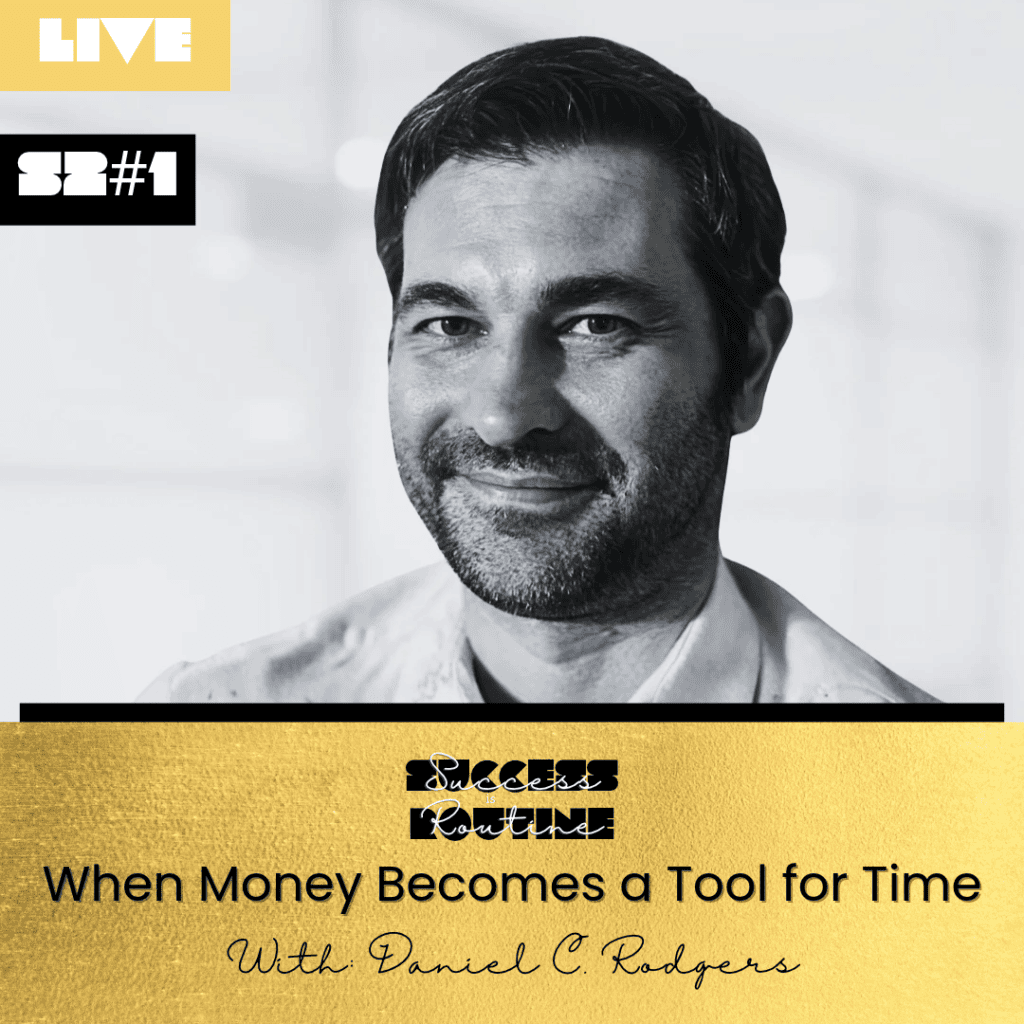
“Survival is not a goal; survival is just a baseline.” Daniel C. Rodgers knows what it is like to spend years focused on getting through the next problem, then discover that survival mode can follow you even after your circumstances improve.
Hannah Mitrea speaks with Daniel, a former Microsoft and Google program manager who reached financial independence and retired from corporate work at 43. For him, money became less about accumulation and more about controlling his time.
He explains how significant debt, costly decisions, and a simple Excel sheet gradually changed how he saw his life. What began as spending data became a personal program with measurable goals, milestones, and clearer decisions.
One of Daniel’s most useful shifts was moving away from net worth as the only score. He built KPIs around the life he actually wanted, while also recognizing why a steady paycheck creates psychological safety and can become part of the “golden handcuffs” of work.
(4:58) Growing up in survival mode and learning to self-educate
(8:15) Choosing a career for income, not identity
(11:47) How “next year” quietly becomes a decade
(12:44) Reading financial rules as instructions, not restrictions
(15:38) When financial mistakes start costing you time
(19:06) Why the wrong KPI becomes a vanity metric
(23:43) Eight years before the plan felt real
(25:02) Moving across the country to change the math
(28:36) What happens when reclaimed time has no plan
(33:52) Turning a spreadsheet into a personal program
(36:17) Financial freedom as removing the requirement to work
If you have ever pushed a meaningful goal to “next year,” this conversation offers a different question: what are you actually measuring toward? Listen for the routines Daniel used to turn financial literacy into something bigger than retirement: the ability to choose how he spends his time.
About Daniel C. Rodgers
Daniel C. Rodgers is a former Microsoft and Google program manager who achieved financial independence and retired from corporate work at 43. He is the author and creator of Escape The Clock, where he shares practical ways to make work optional and take greater control of your time. Daniel now focuses on helping others approach financial freedom with clearer goals, better systems, and intentional planning.
Contact Daniel Today!
Be Our Next Guest!
Your success story might be the spark someone else needs.
Behind every breakthrough are decisions, setbacks, and routines worth talking about. We want to hear yours.
Have a story worth sharing? Join Hannah Mitrea on Success is Routine. Let’s get you behind the mic!
Disclaimer:
The content of Success is Routine is provided for informational and educational purposes only. The views, experiences, and strategies shared by guests are personal to them and should not be considered professional, financial, legal, medical, tax, or business advice. Always consult an appropriate qualified professional before making decisions related to your personal, professional, financial, or business circumstances.
Transcript
Hannah Mitrea 0:04
Hello, everyone. This is Hannah, your host, and you are listening to the Success Is Routine podcast. Our show is on a mission to talk to leaders in life and business that have achieved success, and to learn what their routine is. If you are ready to create your routine to success, you are in the right place. Now let’s get started. Welcome back, everyone. I’m super excited to be bringing back Success is Routine, and one of our first guests is going to be Daniel Rodgers. Daniel is a certified wealth planner, and he is also the author and host of Escape the Clock, a podcast helping people gain financial literacy, and so welcome to the show, Daniel.
Daniel C. Rodgers 0:45
So happy to be here. Thanks for having me.
Hannah Mitrea 0:47
Yeah, I’m. I’m super excited. I know when we connected, we talked a little bit about your story and how you grew up in Ohio. Kind of didn’t see those opportunities, and I related because I grew up in Western Pennsylvania, didn’t see those opportunities, so tell us a little bit more about your story and how you got out of it because you moved across the country back and forth and all the things.
Daniel C. Rodgers 1:10
Yeah, yeah, I grew up moving around Ohio actually, so end up living really all across the state for the most part. We were moving every other year because we were dealing with a lot of financial challenges, and so everything from businesses that weren’t able. My dad had started the business a little early on the movie rental side, and so we had to move, and just a bunch of stuff going on in the industry. And so I was the new kid at school a lot. I was trying to do my best to get by, do all that stuff. And you know, when you’re a kid, you kind of like it seems like you have an unlimited time, like you can do whatever you want. And so, for me, I just remember just thinking, okay, I just got to get through this school year. I just need to get out of this situation. It was always the problems in front of you, and so when you grow up in like poverty situations where you don’t have a lot of money, you kind of just get into a survival mode, and that becomes your norm. And for me, I didn’t-I was a kid. I didn’t really have any control, so I really leaned into school because I felt like okay, maybe there I could take the reins and be able to make some moves, and even though it was tough because I had gaps in my curriculum because we were moving so much, like the school systems don’t coordinate. So I would literally go into a math course that would say, “Okay, you guys should have learned this last year, but I had never even heard of the concept, so I had to learn how to do some self education and and fill some gaps and things like that. But ultimately, my dad was really supportive. If he’s like, okay, you know, for you to make something of your life and not be stuck in this, you got to go to college, you know. And so I we didn’t have any money for that, so I had to borrow all the money for it. I ended up going in state to the Ohio State University many, many times. It was very difficult. I chose computer science there because I had done a Yahoo search at the time, and it said it had a salary. I knew I had to get some income. It’s not because I wanted to do it, not because I was strong at math, just because I knew I could make some money from it. But long story short, there ultimately I did graduate, and I was working while I was in college, and I really became aware of how quickly our time can just be sucked away by that survival mode, and just trying to make a change in your life. But you can, which is great.
Hannah Mitrea 3:36
Yeah, I think you touched on a lot of things that are going to be relatable for people. One that, especially when we’re young, we’re racing for time to just move forward and move forward, and it’s not moving fast enough. And then we get older, and we’re like, slow down, slow down. So I think we all relate there. But then also the idea of just doing a Google search, looking for what is that salary I want to make. Okay, let’s go get that job. I actually teach at university, and it’s very much that same thing there, where they’re all there, where they’re like, “When I get out of here, this is what I want. But that’s not always the whole picture, and just getting that degree sometimes isn’t even what you’re interested in, and so it won’t get you there.
Daniel C. Rodgers 4:19
Yeah.
Hannah Mitrea 4:19
So, what was kind of that switch for you? So like, what flipped that made you go, okay, this isn’t how to do it anymore?
Daniel C. Rodgers 4:27
Yeah, like if I had the luxury of time and picking what I wanted to do, I would have went to school to be a writer. I would have been doing that type of thing, but ended up in computer science and was working at a local company where I was setting up all their tech, and I was absolutely faking it till I can make it. I remember when I was a teenager going into a job interview, talking to the president of this heating and air conditioning company in downtown Columbus, Ohio, and just saying, “Yeah, I could do all that. I could do this. I could do that. And I couldn’t do. I didn’t know any of it. He was. He wanted everything. Website creation, graphics, on-site installations-like now-I understand how ridiculous it was that I could do any of these things. But what really sold him was my dad worked in aerospace engineering, and he was a database programmer. And the thought that my dad could help me, I think, was really exciting for him because he could pay me, you know, a student’s salary, and maybe get the experience of my dad as a professional. So I started doing these things, and I realized really quickly that for me to figure those things out, I needed more time than what I was given in the workday. So I had to go and start researching and learning how to do different things, and you know, I was trying to build a life at the same time. I ended up proposing to my girlfriend, and you know, we got married right out of college. Decided we want to buy a house. Shortly later, had our first child, and all of those things are expensive costs. And so, like you mentioned, like as you’re a kid, it seems like time is almost infinite, but as you start to adult, you start to adulting harder and harder. It’s like time just keeps speeding up. It’s like a treadmill, and someone keeps turning up the speed of it. And you’re just trying so hard to stay on the thing. It’s like okay, wait, okay, now I finally got that degree. Great, that means I have an income. Oh, but at the same time, I mean, student loan deferrals are no longer happening. I have to start paying my student loans. Now I’m supposed to get a house. Oh, there’s a mortgage with that. Oh, I have a job. But with the job comes all these financial decisions about this 401k thing. What is that? Why do I want to put money into that thing? Like, there’s like, all these decisions that just are hitting and hitting and hitting and hitting, and you don’t really understand that each one of those compounds over your lifetime, and some of them are much more serious than others. And there’s just a lack of financial literacy. Sadly, in the country, it’s actually worse than it’s ever been. And some of those decisions, they what they do is they capture you in your job, they entrap you, and so that you can’t really escape the job you end up in. And I didn’t want to be in that job. I was in that job because I felt I had to be. And so what I was starting to wake up to was the fact that I had entrapped myself into a job that was supposed to be a means to an end, make enough money so I could go do the thing I want to do, go write. But it was very clear that that money, that salary, was not going to be sufficient to the costs that were in my life, and some of the mistakes I were making pretty early on being too quick to take on credit card debt, being too quick to take on a mortgage, not knowing I didn’t have credit established yet, so I can’t get a good mortgage interest rate. A lot of those things are very expensive and very difficult to recover from, and so I guess what I realized is that survival mode I was in as a kid had followed me into as an adult, even though technically my status had changed because I was a college-educated person with a good income, but I was still survival mode.
Hannah Mitrea 7:56
Yeah, definitely, and you know what I was hearing that a lot too, as adults we’re like, we’ll do it next year. We’ll do it next year, and so we keep kind of punting the finish line of what we want because you know, money’s not there yet, or life’s just moving so fast, and things like that. Where next year becomes 10 years from now and 15, 20, and all of a sudden, it kind of passes you up fully. And so, really being able to see that early enough because you did, you were able to go work for Google, Microsoft, and then retired at 42. And so, when you’re in the trenches of you know paying the student loan debt, having the mortgage, having babies aren’t cheap ultimately, so having the kid and the money and stuff like that, what was it that helped you get out? And like that probably is a little bit of where we start your routine, I would imagine too. So what was that that trigger?
Daniel C. Rodgers 8:52
Yeah, the first trigger was that self-education I was doing. It just started to wake me up to how difficult things were actually were. Like when you have the blinders on, you don’t actually understand how bad it actually is until you start to kind of see it. So I’m starting to educate myself, and so I ask my dad, like, do I do this 401k thing? He’s like, yeah, that you should absolutely do that. I’m like, oh, I can’t afford that, but I’m going to do it. Absolutely, the right call. But I’m starting to go and understand what these things are, and I’m like looking at there’s all these dates that the government, like the IRS, sets right 59 and a half, you know, 65, 67, 72, like all these dates, and so this idea that somebody else is defining when I’m allowed to not work, when I’m allowed to get help, when I’m allowed to do this, when I’m allowed to do that, and I just did not like that at all. But then I started noticing, like, oh, they’re not trying to punish me. This is a set of instructions in here. It’s a tax code. It’s instructions. So I started looking at it that way, and I said, okay, there’s exceptions, and there’s actually whoa, there’s this thing called a SEPP. You mean I could start getting income before 59 and a half if I do this? So I started learning things, and I realized that what I really needed to do is take these strategies I was learning and start to make them actionable for myself. I needed a success metric, and so I’m a pretty. I became a pretty engineering-oriented person. I was working in engineering, so I started figuring out KPIs, key performance indicators for my life. And so it started with a simple Excel spreadsheet, as most things do, where I’m just trying to organize my data. Right, this is what you might imagine. What is how much am I spending? I take my bank statements and credit card statements for the month. I dump them into a spreadsheet. I would tag things. I would see, oh, this went up. This oh, I didn’t. This charge shouldn’t be there. And I was just trying to optimize spending a little bit. But what I was really doing is I was aggregating data and creating a sense of how I was performing, and it didn’t work all at once. First couple years, it just became something I did just to feel the motion of success. You know, like oh, okay, I’m collecting the data, I’m seeing things, I’m not blind. But eventually, I had enough data. Yeah, the understanding came where I started to see the trends, and I started to be able to use that data to under to make decisions from it.
Hannah Mitrea 11:32
And I bet in a way too, seeing it at like month by month, it keeps that motivation a little bit more too. Where you see that progress. Whereas if you go at the end of the year, I want this six months. You haven’t seen it yet, so you get disappointed.
Daniel C. Rodgers 11:46
Yeah, it’s not always good. Like sometimes we’d have a bad month, and I would talk to my wife. I’m like, we shouldn’t be doing that. And that’s our; those are not fun conversations. It did help us have those conversations. Like I had something real to talk to her about, and we got really good at our spending. We understood we how to live within our means, and we were dealing with $120,000 of debt when we started, and that’s not including the mortgage. That’s just the school, my school debt, and my credit card debt. And then we had to add graduate school for her on top, and then the mortgage. So we were where our net worth was negative half a million dollars, something crazy. It was bad, and so we had a huge hole to dig out of. And of course, we have a kid, and the data for having a kid is very expensive. Like across the 18 years of raising a kid, I think per kid it’s over $160,000. Like, you know, this is just kind of SWAGs. But the idea is like each of these life decisions have a hidden cost to them. And what I was starting to realize is the cost was really my time, like time to have to go figure out what to do. Time lost if I’d made a mistake because then I had to go and spend time fixing something, or working late longer hours, or maybe sadly getting a second job. You know, this is all my time was the one thing I really had to spend when I was making financial mistakes. And so when I started to see those trends, right away it was clear to me I had made some big mistakes. I made mistakes with my mortgage. I had two mortgages because we had taken a second one in order to renovate part of an old house that we bought. Horrible mistake. I mean, that put us so far underwater that we had 0% chance of getting any ROI out of that investment. And a house is supposed to be an investment. Sadly, it’s not. It wasn’t originally, but it kind of turned into that. And so we, we, the thing that was supposed to be our best investment had become our worst investment from that decision. If I had had my data back then, I would have realized right away we couldn’t afford to have taken that that second loan. We just wouldn’t have done that work. Maybe not bought that house, things like that. So we just got better and better, and that sheet kept growing. And I actually got more sophisticated in how I used it. It started becoming milestones, and, you know basically SMART goals, not just. And from there, grew into a task list. So go do these things, communicate in these ways, share this information out, and that we can get into this later, but that became really the bed of how I got all my time back, is that one Excel sheet. It just grew into this thing that empowered me to take control back and become very informed and effective at knowing when someone’s trying to take advantage of me and knowing when I need to make a good decision about something.
Hannah Mitrea 14:41
I love, I love an Excel sheet. I was teaching my class about data actually yesterday, and that’s why I thought I was like, I know it’s boring, but
Daniel C. Rodgers 14:50
yeah
Hannah Mitrea 14:50
I could be in an Excel sheet all day long with y’all. But one question I have is you said you know you started tracking your KPIs, so what was that personal KPI? That like started it all because I think a lot of businesses who are tracking their KPIs, as well as just individuals, struggle to even create what is that KPI that is going to give them valuable impact.
Daniel C. Rodgers 15:13
Yeah, worked. We can get to this later, but I end up working as a product manager for these big tech companies, and it is challenging to figure out the right metric. Now, once you do, there’s a right way to track it, but and get into that in a moment. But to answer the question, you have to really, really be honest and true about what the goal is. If you don’t know what that success is, and you can’t see yourself excited by that success, then you’re going to not have the intrinsic motivation to get there, so the KPI is just pointless. It’s just a vanity metric, and I ended up with some vanity metrics. Net worth is a vanity metric. It is a lot of people go net worth. Get your net worth really high, but the truth is, net worth is, really wealthy people have not great net worth sometimes because they use leverage. They actually their liabilities are high because they know they can borrow well, keeping their taxes down. So net worth isn’t actually a great metric. For me, I knew my real goal was to not have to work anymore. I wanted to have. I wanted to write. That’s it. I wanted to write, and I didn’t want to have to worry about the books being successful. I didn’t have to worry about money. So for me, I had to understand deeply my costs, my longevity, and then I had to track that I had the money in the right places, that the risk was mitigated, that the money would last, and so I started, instead of tracking net worth as this one big number, I started tracking three numbers. I started tracking an early retirement savings goal, which I called ERS, and then I started tracking a full retirement savings goal or FRS, and then I started tracking early retirement passive income. And so I these are all in my my book, all the equations and how I did all this stuff, but the point is the reason I did three numbers is is one because of those dates the IRS sets. You actually are gated to get access to certain things that you’re you’re putting money into, like vaults that you’re you know IRAs and 401k’s, and then other things like Social Security or Medicare. Those things are gated from you, so you have to bridge the time before you have access to those. So, but you still want to put money into those places so the seeds can grow. So I had a smaller ceiling there because I knew time was going to do a lot of the heavy lifting. So I had to get enough seed put in place into those vaults, and then I had to get do the heavy lifting in the early retirement places, and it’s not just it wasn’t just one account. Like a lot of people in the FIRE community, the FIRE, the financial independence retire early movement, they love the brokerage account. The idea that you put money into a stock investment portfolio that’s a taxable one, and it grows, and that’s where you live off of. That’s fine, and I had one of those, but for me, it was more than that. I wanted a paycheck. I don’t like the idea of not working and not having money still coming in. There’s a psychological safety with that, and there’s a reason they call the work, you know, work holding you their golden handcuffs, because they realize that paycheck is really holding you to the job, because you feel safe because you’re getting these currencies from that job, social connection, a sense of identity, and mostly a steady stream of income. So having just enough money sitting in a brokerage account wasn’t enough for me. I had a milestone, a measurable goal or KPI that I would have enough money set up as income sources, and I can get into how I did that. It was actually a set of things I went for because I wanted redundancy and diversification. It wasn’t just dividends. It wasn’t just like royalties. It wasn’t just like it wasn’t a second job, but you know, there’s lots of things you can do to have enough cash flowing in where even if you’re sleeping, you’re making money, and I wanted that in place as well.
Hannah Mitrea 19:10
Yeah, I think I think that’s the ultimate dream for a lot of people, right there. And so it’s really interesting to hear how you looked at the tax code and understood. Okay, this is when I’ll start getting these things, and created those three separate accounts to kind of buffer in between different things that’ll be coming to you. So through creating this spreadsheet, creating these KPI numbers, you know, at first you’re not going to see results instantly. So how long did it take for you to start seeing that result and to really have this stick for you?
Daniel C. Rodgers 19:47
Eight years, which is maybe not the most encouraging number that people want to hear. It took me 20 years to retire, so I started. I had set a 25-year retirement goal. Okay, let’s be so I was around 25 when I started, when I set serious retirement goal. I ended up I thought I would retire by the time I was 45. I ended up retiring. I declared my retirement at 42, and I was officially retired by 43. We can get into the psychology of when you’re done and you stay, which is kind of stupid, but I left at 43, so I beat my goal by two years. But it took me about eight years before I felt like I knew I was going to make it, and I had to make moves to get to that point. Like just doing what I was doing wasn’t going to work, like I couldn’t just grind harder where I was. I had to make some big moves. Yeah
Hannah Mitrea 20:46
Yeah, because that was going to be my question. Like, what helped you stick through those eight years? Because I think that’s where people are. Like, eight years is a long time, but being able to retire that much early makes it worth it. You know. So what got you through those eight years when you didn’t know if it was actually working?
Daniel C. Rodgers 21:05
Yeah, so that was eight years for me. That’s not going to be the number for everyone, right? People are in different situations. I was really, really buried in debt and had made some bad choices, so I had to climb out of those things, and that required me making some pretty big moves. For me, Ohio has a bit of a ceiling to what I can make, but the costs are lower too. But I had to do this thing called geographic arbitrage, or basically, it’s like I just moved. I just moved across the country, so I could increase. Sounds like the other way. It’s the name of it’s cool, but it’s just move. You just moved, so I literally moved my financial burden and potential, and so that was good. I had to do stuff like that though, and I my wife was super supportive. I was like, okay, look, I can’t make more money where we are. We’re gonna never really improve our lifestyle much past this, but I got an offer at Microsoft. It’s going to pay this much money. Yes, it’s more expensive out there. We’re going to have to make some sacrifices, but it will-I promise-get me to this goal, and it’ll be worth it. And she gave up everything to her family, her best friends, everything-and moved to a place where she knew nobody and made that sacrifice. It was amazing, but it worked. It really did, and dude, so that’s what I mean. Like, yeah, once you get the data and you start seeing it, it becomes really clear. Like, okay, I got to change something, and you don’t have to feel stuck. Like, there were times I felt stuck, but then I started to really think about it and talk to people, and sort of okay, there are options here, and sometimes I’m just kind of scared about that option. It’s not a fun one, but maybe it’s the one to do, you know. But yeah, that after about eight years, I was a point where we were actually not only kind of green, where we had dealt, we had more assets and liabilities, but the compounding was working. I could see that things were actually growing at a rate in my projections that I would be past my goal by the time I was there. And I made some other moves along the way, but I made those moves. I made riskier moves because I felt like I had more risk capacity. There’s risk tolerance and risk capacity. A lot of people know what risk tolerance is. It’s how much risk am I willing to take, but risk capacity is how much can you afford to take, and as you do better, you can afford to take more risks. And I think wealthier people, I was realizing, was doing this a lot. They were willing to make some crazy investment in something, and sometimes they were being really smart about it, and it was paying off. And so I was trying to emulate things like that, and that can speed you up quite a bit.
Hannah Mitrea 23:44
Yeah, I think that’s, you know, one way that I know I look at money is we don’t risk what we can’t afford to lose, and so I think that falls into that risk capacity because it definitely it makes a difference where you’re able to then not have this fear of taking that risk because you understand that either way it goes, if it goes good, you’re gonna get out of it good. If it doesn’t, that’s unfortunate. You know, you’re doing that. The one thing, so I’m kind of like, I want to get into the nitty-gritty real quick. What does this actually look like? Are you every day logging into your spreadsheet, calculating everything, or after every transaction, after or is it like a weekly thing that you have set up? Because I think that’s where people get so overwhelmed with spreadsheets.
Daniel C. Rodgers 24:28
Sure,
Hannah Mitrea 24:29
Sorry, spreadsheets. So what does that look like for you? What’s that like the actual day-to-day, or is it weekly? Is it minutely? You know.
Daniel C. Rodgers 24:39
Yeah. So, good question. When I was younger, it was a daily activity I did because I needed to feel like I was doing something about my situation, and I liked having up-to-date information and kind of seeing where I was going. Now I maybe update it once a quarter, three months, maybe. Because I’m in a situation where I’m not worried as much anymore. Now I have other things I spend time in. I have a spreadsheet where I track stock options and things like that. Because I have that’s fun. I do it because I enjoy it, not because I have to do it. But I also, the tooling is better now. Now that I got my time back, I have all these different kind of ways I keep myself on track. I do time blocking so that because I learned like as soon as I enter my early retirement, time is very liquid. If you don’t have a plan on how to use it, it will just kind of get used. And I realized I was just thrashing around, doing all these other things all the time. I wasn’t working anymore, but I was just running around and doing all these errands and doing all these things. And it’s like, what am I doing? This isn’t what I wanted to spend my time on. So I started getting very organized, and so I started doing transparent time blocking in a calendar, where it’s like, okay, I’m going to spend X amount of time on my writing. I’m going to spend. I’m going to make a routine out of doing my health goals, doing my workouts. I’m, you know, I do dog rescue with a nonprofit, so I’m going to be doing dog training at this time, dog walking. I’m going to. I got to take my daughter to this thing. I got to pick up. I got to do this, and so it started to grow, and I love the calendar so much because the calendar one you can do transparent time blocking. Everyone can see it. Now, that only works if people respect your time. I will promise you that if you try to do transparent time blocking at the shared calendar with your family, friends, or whatever, and they don’t respect your time, they’ll just see things and just put something on top of it. But when they respect your time, it’s amazing. They’re like, okay, they won’t schedule over it. They’ll leave you alone. Oh, okay, Dad’s recording a podcast right now. It’ll be quiet. You know that it became this amazing way of communicating, and then other people started using it because I encourage them to. Now I can see what other people are doing, and I can be part of that. And it just became this way of organizing my time that I reclaimed, that just felt really great. Now my kids make fun of me a little bit and say, “Oh, if it’s not in the calendar, then Dad doesn’t know about it. So you know, they kind of do stuff like that. But that’s
Daniel C. Rodgers 27:20
Yeah, that’s fine. Maybe you can go too far with it. It’s up to you to do a little bit. The other thing I started doing is it’s kind of like a time training where I started like trying to I wouldn’t say condition, but just be really clear in my communication expectations that I communicate this way most effectively. If you’re going to email me, you’re not going to get a response until the next day. If you text me, I’ll try to respond to you within the day. If you ping me through this app, I’ll likely see it. You know, I’ve tried to like lay expectations up front with people because what I was noticing is miscommunications were costing me a lot of time, and it was slowing me down, and it was creating frustration. And I don’t want to. I want to be there. I want to be available. So people just needed to know what’s the right way to do it. And the calendar is one of those forms of communication. Putting an event in the calendar is telling me you need me to be somewhere in a certain place, and you know, and me accepting it, saying I’m committing to you to do that. This stuff is probably obvious to a lot of people, but when you do it deliberately as a part of time management, as a strategy, and then you’re measuring how successful you are, it’s great because you can see in a day, in a week, in a month a visual, especially if you color code or do other ways with it. How you’re spending your time, and you can balance how much am I doing for personal growth versus family versus business versus this versus that. You can really start to get an idea of how you’re doing with your balance, and then you can get into things like time hacking, where you can start optimizing how you’re spending a block of time to make it more effective, but that’s generally what I was doing. And now tools are so good, I’m using things like AI and other things to automate pieces. I’ve automated pieces in my calendar. I use text-to-speech a lot, so if I’m on a dog walk, I can still talk to my phone to schedule something to do something. I just I might sound a little neurotic, but the truth is, I’m making my time count when in the way I’m spending it, so I have more free time, so I can just sit back and do nothing sometimes, and not have any stress or worry or distraction. And those are the best moments of the day.
Hannah Mitrea 29:36
Yeah, it sounds like you’re really making your time work for you, not the other way around for sure, and so one question here would be: You know, we talked about the spreadsheets, and then we talked about the, you created this calendar for transparency. Did they coincide, or did one come after the other a little bit more?
Daniel C. Rodgers 29:53
The calendar came after the spreadsheet. The spreadsheet was a program, and this is what I teach in my book because. When I did my early retirement, I was working at Google at the time, and all these people were asking me, like, like, how are you doing this? I was a program manager. I wasn’t making as much money as the people I was working with. I was working with senior VPs and executives, and I was really close to a lot of these folks. And we were talking, and like, you know, I feel like I’m. I’ll be lucky if I retire when I’m 60. Like, I don’t understand how you’re doing this, and I’m like, well, like where’s your spreadsheet? How are you tracking? And there was nothing, and it was really clear. A lot of people are kind of in this autopilot mode. There’s nothing wrong with that. Life is set up for that. But when you’re in an autopilot mode, you don’t know where you are on that journey. You don’t know how far away you are from the goal. You don’t know if you’re even on track for the goal, and so they people really wanted me to capture how I had done that. So I agreed I was going to write anyways. So I wrote, you know, Escape the Clock, and I wrote that book, and it has all the stuff in there, and this how the spreadsheet grew into this program plan. Because the reason I call it a program plan is because as a program manager, that’s really what I was. It evolved into. It had you know dates on the on a calendar, which were milestones I were working toward, which have which had specific, measurable, attainable, time relevant goals to them, and I could track it. And this is something I give away for free, by the way. Like, you can go on to the escapetheclock.com website, and I give away that spreadsheet, that Excel sheet turned into a Google Sheet, which now is this really smart program tool that anyone can use to plug in your financial information, set your own goals, and track your progress. You don’t have to build this from scratch. I wanted anyone to be able to do that. I spent 20 years on this thing. Like, don’t start from scratch, please.
Hannah Mitrea 31:43
No, I love that you have that available for people to be able to access because I think sometimes creating the spreadsheet could be what stopped them from
Daniel C. Rodgers 31:53
oh yeah
Hannah Mitrea 31:53
filling out the spreadsheet. So I love that you can go to your website and get that there. But I do like to kind of I don’t want to make sure we respect your time too here, and wrap up a little bit with how you define success. And I know you said you define success by accomplishing one goal that defines your success. Correct? That’s kind of how you wrote it for me. So, what does that mean to you? Whenever we look at, like success, I mean,
Daniel C. Rodgers 32:19
we all have to have that meta goal in our lives that we all care about, right? It can’t just be get through the motion, do the survival thing, right? Like, survival is not a goal; survival is just a baseline. So we have to have that thing we’re striving for. And if it’s a job, fantastic. Financial freedom is not about quitting work; it’s about having enough money that you’re not beholden to have to work when you don’t want to. So the financial thing is just getting rid of a variable. And so for me, it was writing. My second book just came out. It’s a science fiction book, the kind of thing I always wanted to do. That was success for me. Was I got to write that book, and coincidentally, it also touches on time because it explores, in a science fiction, speculative way this idea of artificial intelligence and the future we’re all about to experience when we delegate our time away to something smarter than we can ever be when we have an AI after singularity? There’s an AI superintelligence that is sentient, that’s thinking for itself. It’s not based on context like we experience today, where we have to give it context and a prompt, and it’s responding. This is something that’s has a neural network that’s thinking for itself, that’s self-motivated. What happens when it starts doing things so much better than we can do, so much faster than we can do. What happens to the value of our time then? So I explore that in the science fiction book I wrote, and that’s the kind of thing I like doing. I like thinking about success and these things, and getting people to talk and think about them. Because at the end of the day, what it comes down to is people realizing we have all these tools out there, and that if you take the time to do a little bit of that self-education, use the right tool, and you are honest about what your happy version of your life looks like, and that that goal is to get to there, then these things are just means to an end. And you know, as long as we help each other with it, you know, share some of these tools, like anyone can get there. And that I, that’s why I’m doing the podcasting and the books now. Is like I’m trying to share some of those things with others because my success can be someone else’s success, and I can learn from them, vice versa. And I think once we all start doing that, we all get there much faster.
Hannah Mitrea 34:34
I love that. That’s the goal of Success is Routine is to help people learn how people are getting successful, and how can you kind of you know mimic those? Just like you said, you created the spreadsheet; it’s already out there. Don’t go redo it. I feel like the same can be said with different routines; they’ve already been established. Instead of us trying to go and completely create what we want to do, it’s like let’s look at the patterns. Let’s look at the habits that have already been there. So I appreciate you, Daniel, for sharing those with us, and let people know how can they connect with you, how can they read your books and listen to your podcasts.
Daniel C. Rodgers 35:10
Yeah, I’m trying to make it easy for folks. It’s all on escapetheclock.com. You can find the finance book there. You can find my new book, Kill Switch, which is that science fiction book I just mentioned. It just came out eight days ago. Amazing, yeah. Just won a best book award, so I’m very excited about it. But I also give free time away, so time is a currency I know. But you can schedule free time with me, where I just go, and I will help get you set up in that spreadsheet and go through your program together. I was a program manager. I I built the spreadsheet. I’m a wealth manager. I’m very happy to sit down and help you get started with that completely free. I promise you, I will never ask you for money. But if you want to support me, I have a podcast. It’s also called Escape the Clock. You can find it on that website, or you can buy one of those books. If I made them as cheap as I was allowed, but please take a look if you’re interested in those. But otherwise, yeah, please grab the free spreadsheet. Anything that tool will help you get started. At least you won’t have a blank canvas.
Hannah Mitrea 36:13
Amazing. Well, thank you so much, Daniel, for sharing all that. I definitely, I read a lot of books, and so I’ll be interested in your sci-fi book as well as your Escape the Clock, and looking at that. So thank you so much for joining us today, and everybody that’s listening, go over to escapetheclock.com as well to learn more about Daniel and his strategies. So thanks so much.
Daniel C. Rodgers 36:36
Yeah, thanks for having me.